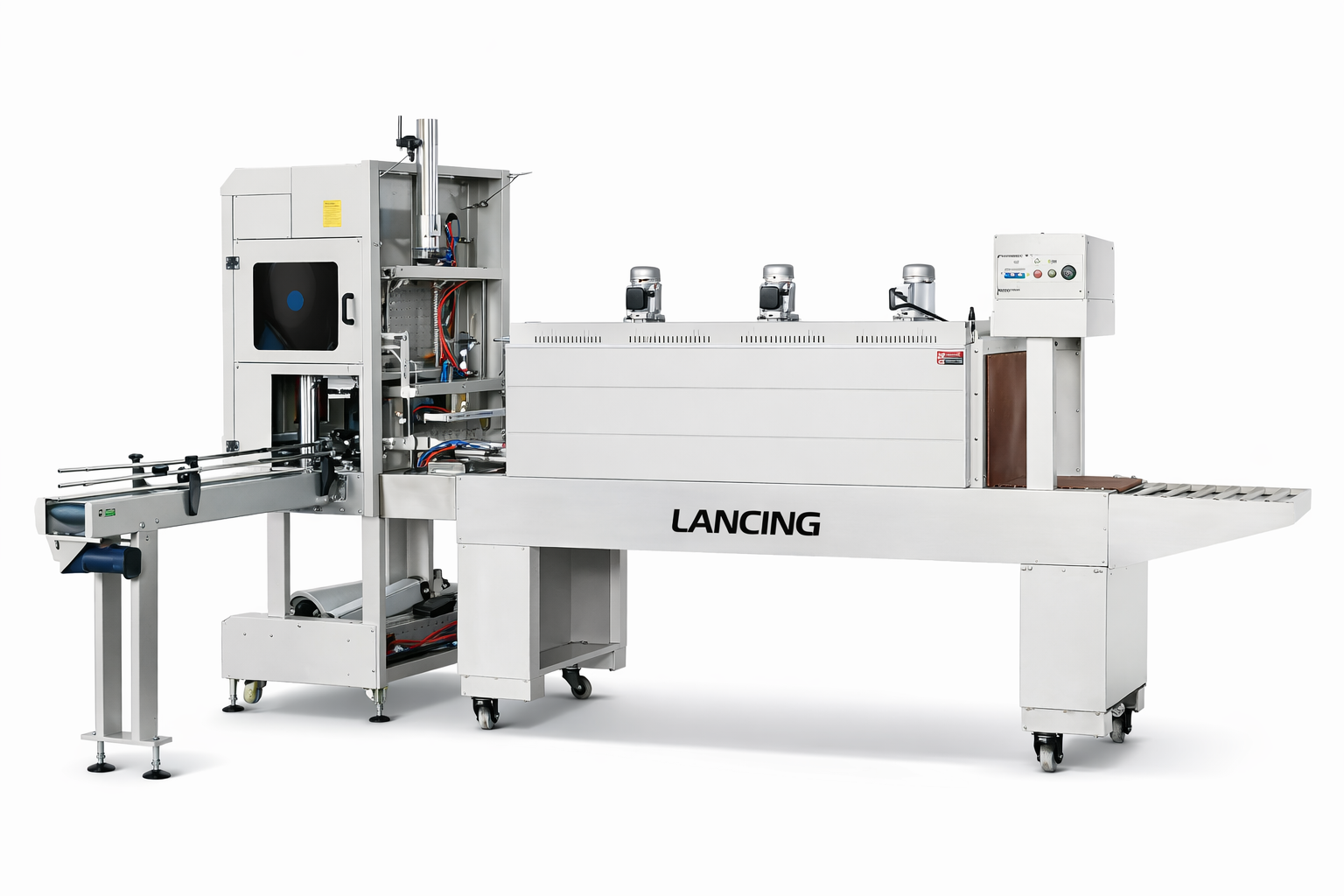
Technical selection guidance
Specify the bundle, film sleeve and handling duty together
A sleeve sealer is selected around the complete multipack rather than the individual container. Group formation, film width, seal position, tunnel process and cooling all contribute to whether the pack remains square and strong through downstream handling.
The LU-SPL4 reference below provides verified starting data for a bottle-wrapping route. Final performance must be checked with the exact bottles, pack patterns, PE film and acceptance test.
Pack pattern and group stability
Define the exact arrangement, including rows, columns, tray or pad, and whether the container is full, empty or partly filled. A group that appears stable by hand may spread or rotate when accelerated through a collator, film curtain and tunnel.
Test the lightest and tallest formats as well as the heaviest pack. Guide rails and transfers should control the group without scuffing labels or trapping containers against the film.
PE film and sleeve formation
Sleeve-wrapped multipacks often use PE film because the route can create a robust transport bundle with open sides. Film gauge, layflat width, reel weight, shrink direction, print repeat and perforation must be agreed with the machine and tunnel process.
The seal must be placed where it is protected from direct mechanical damage and where the film can contract evenly. Excess film wastes material and can produce heavy fins; too little film can overstress the seal or pull the group out of alignment.
Collation, sealing and tunnel timing
Automatic output depends on the sequence of group formation, product stop, film feed, seal cycle and transfer into the tunnel. State whether the infeed supplies a continuous stream or pre-arranged groups and whether missing-container detection is required.
The tunnel recipe must shrink the sleeve without causing container lean, label marking or tray distortion. Cooling and discharge support should hold the group until the film has set.
Acceptance tests for multipacks
Agree a visual standard for film tension, side openings and seal position, then add handling tests that reflect the real supply chain. These may include conveyor transfer, manual lift, stacking or a defined journey through downstream equipment.
Record the pack weight, product temperature, film batch, conveyor speed and tunnel settings used for the approved sample. A photograph alone is insufficient if the bundle must also meet a handling requirement.
Technical questions buyers ask
What products can be assessed for sleeve sealing?
Grouped bottles, cans, cartons, trays and other stable multipacks can be assessed. The actual pack pattern, weight, product stability, film and handling requirement determine suitability.
Does a sleeve sealer fully enclose the pack?
A typical sleeve route wraps film around the group and leaves openings at the sides. Where full enclosure and a retail overwrap are required, an L-sealer or another full-wrap system may be more appropriate.
Why is cooling important for PE multipacks?
The film and seal remain warm as the bundle exits the tunnel. Supporting and cooling the pack before lifting, gripping, stacking or changing conveyor direction helps the film set without distortion.
What should be supplied for a bottle-multipack trial?
Supply filled production bottles, caps and labels, every pack pattern, trays or pads, the intended PE reel, required output and the handling test the finished bundle must pass.
Can printed film be used?
Printed film can be considered, but repeat length, print orientation, registration requirement, film construction and reel presentation must be confirmed. The trial should use production-equivalent print and film.
Where can I find more specialist sleeve-sealer information?
The related sleeve sealers website covers the specialist bundling category. This page retains the broader relationship between sleeve sealing, heat tunnels and complete shrink-wrapping lines.